
Post not found
We couldn't find an article matching that link. Browse all insights instead.
View All InsightsWhy Growth Slows When Systems Don't Speak to Each Other
Growth doesn't only slow because demand weakens. Sometimes it slows because disconnected systems create more friction than the business can absorb.
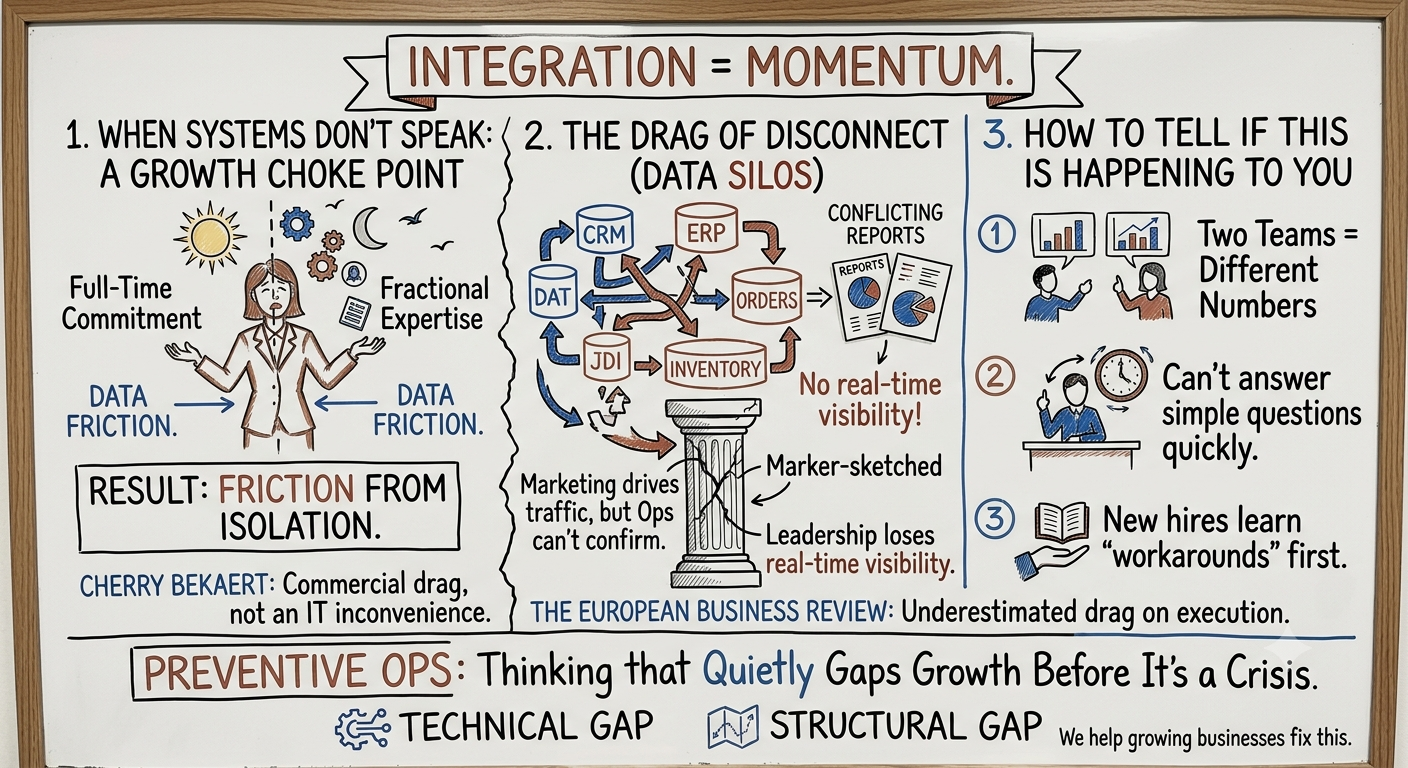
Growth does not only slow because demand weakens. Sometimes it slows because the business cannot keep up with itself. When systems do not speak to each other, every new sale, channel, or process adds more friction. Data has to be copied, checked, corrected, or explained. That slows the team down and makes it harder to scale efficiently. When teams stop trusting the numbers Disconnected systems also make it harder to trust the numbers. If reports do not line up, teams spend time debating data instead of acting on it. That delays decisions and creates confusion at the exact moment the business needs speed. The European Business Review's analysis of data silos describes this as one of the most underestimated drags on strategy execution — not because the data is wrong, but because nobody fully trusts it. Marketing drives traffic, but operations can't confirm it can be fulfilled.Operations struggles to reconcile demand against systems that don't agree with each other.Leadership loses real-time visibility into what's actually happening across the business. Integration is a growth issue, not a technical one This is why system integration is not just a technical issue. It is a growth issue. Cherry Bekaert's research on the cost of data silos frames disconnected CRM and ERP systems as a direct commercial drag, not an IT inconvenience — the same pattern shows up wherever inventory, orders, and fulfilment data live in separate places. When the stack is connected properly, decisions are faster, teams are less stretched, and the business can scale with fewer surprises. If systems do not speak to each other, the business eventually spends more time managing friction than building momentum. How to tell if this is already happening to you Two teams present different numbers for the same metric in the same meeting.A simple question — "what did we sell yesterday?" — takes more than a few minutes to answer with confidence.New starters spend their first weeks learning workarounds instead of the actual business. Any one of these is a sign the stack is working against the team rather than for it. We help growing businesses fix this through both AI & automation and digital strategy engagements, depending on whether the fix is technical, structural, or both.