
Post not found
We couldn't find an article matching that link. Browse all insights instead.
View All InsightsThe Cost of Treating Operations as an Afterthought
Operations are often left until after strategy, after launch, or after growth appears. That's usually the moment the cost becomes highest.
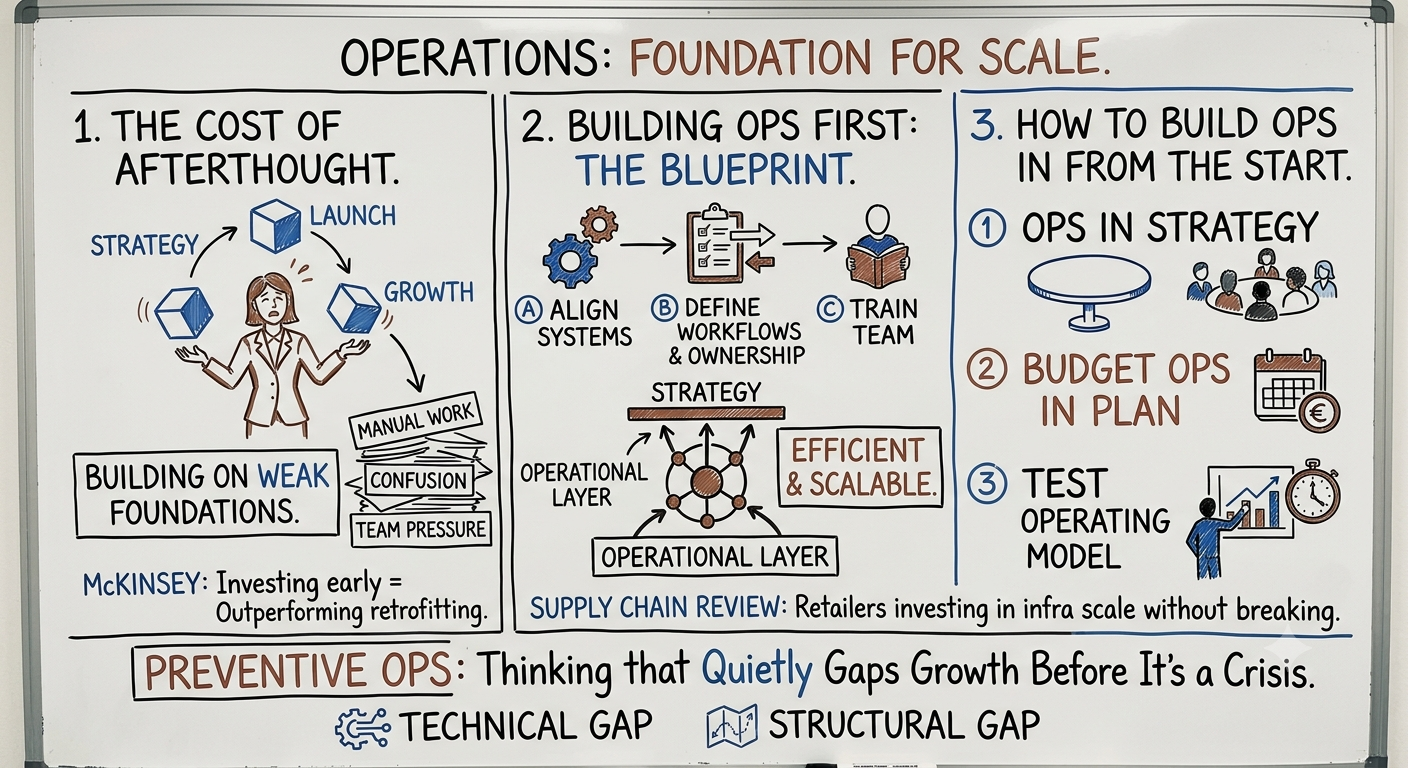
Operations are often treated as something to sort out after strategy, after launch, or after growth starts to appear. That is usually when the cost becomes highest. Efficient now, expensive later When operations are an afterthought, the business ends up building change on top of weak foundations. The result is more manual work, more confusion, and more pressure on the team to make the strategy work despite the lack of support. This approach often looks efficient at first because it avoids delay. In reality, it just pushes the cost downstream. Problems that could have been prevented early become more expensive to fix later. McKinsey's research on digital transformation consistently finds that the businesses which invest in operational foundations early outperform the ones that try to retrofit them after the fact. What building operations first actually looks like Aligning systems before scale arrives, not after.Defining workflows and ownership as part of the plan, not as a fix once things break.Making sure the team understands how the new model works before it's put under pressure. Strong businesses do the opposite of treating operations as an afterthought. They build the operational layer early so the strategy can actually hold. Supply Chain Management Review's research on omnichannel retail shows the same pattern from the retail side: the businesses that invest in inventory and fulfilment infrastructure ahead of growth are the ones that scale it without breaking. When operations are treated properly, everything else becomes easier to execute. How to build operations in from the start Give operations a seat in the strategy conversation, not just the delivery meeting.Budget time and resource for workflow and systems work as part of the plan, not as a contingency.Test the operating model with real workload before scale arrives, not after it does. Businesses that do this spend less time firefighting later. It's the thinking behind our operational excellence work — fixing the operational gaps that quietly cap growth before they show up as a crisis.