
Post not found
We couldn't find an article matching that link. Browse all insights instead.
View All InsightsCould AI Email Personalisation Cut Your Churn? A Practical Walkthrough for Small Retailers
A worked example of how small retailers use AI-driven segmentation and personalisation to make email lists more valuable — and where most pilots actually go wrong.
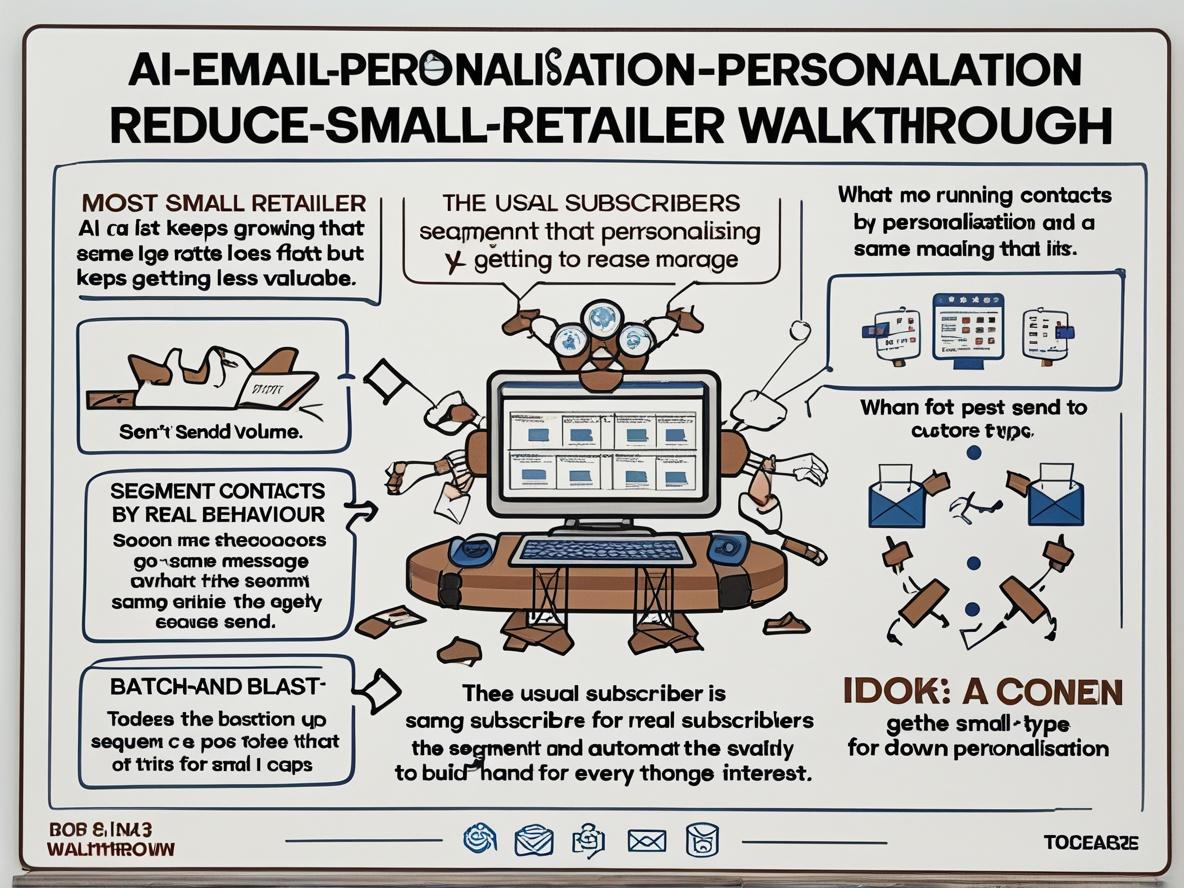
Most small retailers have the same email problem: a list that keeps growing but keeps getting less valuable. Open rates flatten, click-throughs get inconsistent, and a chunk of subscribers quietly go cold after the first few sends. The usual cause isn't send volume — it's that every subscriber is getting the same message regardless of what they've actually shown interest in. AI-driven personalisation is one of the more mature small-business AI use cases precisely because the mechanics are well understood: segment contacts by real behaviour, tailor the message to the segment, and automate the follow-up sequences that a small team doesn't have time to build by hand for every customer type. Here's what that workflow typically looks like in practice, and where it tends to break down. The starting problem: batch-and-blast Before introducing any personalisation, most small retailers are running broad campaigns — the same welcome flow for new subscribers and repeat buyers, the same promotion for seasonal shoppers and bargain hunters, no structured way to re-engage anyone who's gone quiet. That's not a content problem, it's a targeting problem, and it caps how much value the list can generate no matter how good the copy is. What actually changes with AI-assisted personalisation The shift typically happens in three areas. First, AI-assisted segmentation groups contacts by purchase history, browsing behaviour, and engagement level rather than one broad list. Second, AI helps generate and test subject line and product-recommendation variants faster than a small team can manually. Third, triggered sequences — abandoned cart, post-purchase cross-sell, win-back — get built once and then run continuously, rather than depending on someone remembering to send them. The research backs the direction of travel here: HBR's 2026 research on personalisation notes that the psychological principles behind effective targeting — relevance, timing, and specificity — matter more to customer response than volume or frequency. Fewer, more relevant emails consistently outperform more generic ones. Where pilots actually go wrong The most common failure mode isn't the AI tooling — it's stopping at isolated tactics instead of rebuilding the workflow around them. McKinsey's research on AI-powered personalisation found that most marketing teams have adopted AI tools but are using them in disconnected ways, which produces modest results rather than the step-change they expected. A retailer that turns on AI subject-line suggestions but keeps sending the same segment structure will see a small lift at best. The bigger gains come from rebuilding segmentation and automation together, not layering AI on top of the old approach. A realistic first pilot A workable starting scope for a small retailer looks like this: pull customer and engagement data from the existing ecommerce platform, use AI to propose 3-4 behavioural segments and draft message variants for each, have a person review every draft for tone and accuracy before anything sends, then launch triggered flows for abandoned cart, post-purchase, and win-back specifically. The tooling requirement is modest — a standard email platform with AI-assisted features and clean customer data is usually enough; this doesn't need custom development to start. Track churn (or unsubscribe rate), click-through rate, and repeat purchase rate against the previous quarter's baseline, and give the pilot a full billing cycle before judging it. Because the goal is relevance rather than volume, a smaller, better-targeted send list that keeps more subscribers active over time is the right outcome to look for — not a bigger one. Practical checklist before you pilot - Clean your customer/engagement data before segmenting — AI segmentation is only as good as the data underneath it. - Keep a human review step on every AI-drafted send until you trust the tone consistently. - Rebuild segmentation and automation together rather than bolting AI onto an unchanged campaign structure. If your team doesn't have the time to rebuild this properly around AI, that's the kind of hands-on delivery work we take on directly under eCommerce Growth — not just advising on the approach, but building the segmentation and automation with you.